

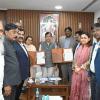
The company has signed a memorandum of understanding (MoU) with Invest UP to set up the facility in Meerut. The proposed project is expected to generate direct employment for around 300 people and indirect employment for 1,000 people, while strengthening the state’s emerging technology-driven industrial sector.
UP Startup Mission CEO Sumit Mahajan said the Yogi government is focusing on encouraging local entrepreneurs, startups and technology-based industries. Through the UP Startup Mission, efforts are being made to turn new ideas into commercial projects and provide startups with opportunities to grow.
The proposed refinery in Meerut is an important step towards connecting local startups in Uttar Pradesh with large-scale industrial investment. The project is expected to encourage the development of new technology-based industries in western Uttar Pradesh.
The refinery will be developed in phases. Once it reaches full capacity, the facility is planned to process 10,000 tonnes of material annually.
The plant will recover valuable minerals, including lithium, cobalt and nickel, from used lithium-ion batteries. It will also extract rare earth elements such as neodymium, dysprosium and terbium from discarded permanent magnets used in electronic devices, hard drives and electric vehicle motors.
These minerals are used in electric vehicles, renewable energy, electronics and the defence sector. They play an important role in applications ranging from electric vehicle batteries and modern technological equipment to energy generation plants.
Recovering these minerals from discarded batteries and electronic equipment could improve resource utilisation while helping strengthen domestic supply chains.
Reducing Dependence on Imports
The company’s CEO said India meets almost its entire domestic requirement for lithium, cobalt and nickel through imports. Dependence on imports for rare earth magnets is also a major challenge.
Developing domestic recycling and refining capacity has therefore become increasingly important. The Government of India has taken several steps to promote self-reliance in critical minerals, with the National Critical Minerals Mission focusing on strengthening the entire supply chain for these resources.
The mission includes a ₹1,500 crore incentive scheme to encourage the recycling of critical minerals from electronic waste and used batteries.
In addition, the Union Cabinet approved a ₹7,280 crore scheme in November 2025 to promote the manufacturing of rare earth permanent magnets in India. The scheme aims to develop an annual production capacity of 6,000 tonnes.
Recycled minerals and rare earth oxides recovered through Circulogy’s proposed refinery could support such domestic industrial supply chains, potentially contributing to efforts to reduce import dependence.
Support Through the UP Startup Mission
Meerut-based Circulogy is a Department for Promotion of Industry and Internal Trade (DPIIT)-recognised deep-tech startup working in the circular economy, with a focus on recycling and the reuse of resources.
The company has received support from the UP Startup Mission under Uttar Pradesh’s startup ecosystem.
Under the MoU, the Yogi government will facilitate the process of obtaining the necessary clearances and approvals. Support will also be provided to help the project access incentive schemes offered by the Central and state governments, subject to applicable rules.
The proposed investment of around ₹200 crore is expected to create new employment opportunities while expanding the state’s emerging technology-based industries.
The project could also broaden Meerut’s industrial profile, adding critical mineral recycling and refining to its existing industrial activities. Its proposed annual processing capacity of 10,000 tonnes, along with the planned recovery of battery minerals and rare earth elements, places the facility among the initiatives aimed at strengthening domestic resource recovery and industrial supply chains.
About The Author









Comment List